
A Camera Rollout That Has a Lesson for Every Contractor Running Pickups and Vans
When a ready-mix company deploys AI dash cams, the reasoning is obvious. A loaded mixer is a rolling worst-case scenario, and IntelliShift’s recent customer story on Geiger Ready-Mix — a five-generation Kansas City operation running six plants across Kansas and Missouri — sits squarely in that tradition.
But if you manage a fleet of Class 2-6 trucks — service bodies, cargo vans, crew cabs, small dumps — the heavy-truck framing can be misleading. It suggests video telematics is a big-iron problem. The published results say the opposite.
The best proof points are light-duty contractor fleets
Look at who IntelliShift actually put numbers behind in its customer results release. Fox Electric, an Arlington, Texas electrical contractor running 180 vehicles, reported an 85% reduction in vehicle accidents within six months. Day & Nite, a 145-vehicle commercial refrigeration and HVAC service company, cut rear-end collisions 75%, reduced in-cab phone use 90%, and lifted safety scores more than 80%. Paraco Gas, at 280 vehicles, reported a 53% accident reduction.
Those are not heavy haul operations. Those are technicians in vans and pickups making six to ten stops a day — the same profile as most contractor fleets in this market.
Why the risk profile is different at your weight class
Medium and light duty contractor fleets rarely have a single catastrophic exposure. They have volume. A tech running 120 miles a day through residential streets and congested job sites accumulates far more decision points than an over-the-road driver, and the incidents that result are mostly unglamorous: backing into a customer’s mailbox, clipping a parked car in a tight cul-de-sac, a rear-end at a light while glancing at a dispatch message.
Individually those are $3,000 problems. Across 80 trucks and a full year, they are a budget line — and they are the events most likely to compound into a claim you cannot defend.
Three structural factors make this worse in contractor fleets specifically:
- No safety department. Most fleets under 200 units have a fleet manager wearing four hats, not a dedicated safety team reviewing footage.
- Turnover. Skilled-trade hiring churn means you are coaching a partly new roster every year.
- Take-home vehicles. Personal use blurs the line on who was driving and when, which is exactly the ambiguity that sinks a claim defense.
The scorecard is the product, not the camera
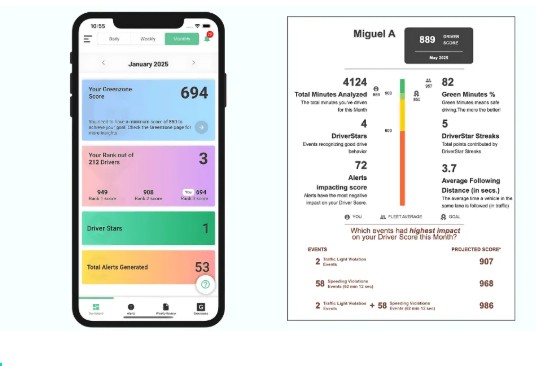
This is the part fleets get wrong. IntelliShift’s AI Dash Cam 400 launch data, from a 30-day study of 8,054 vehicles, reported a 9x reduction in harsh driving events — hard braking, speeding, rapid acceleration — when cameras were paired with driver scorecards. The camera captures. The scorecard changes behavior.
Practically, that means a weekly two-minute conversation about trends, not a monthly meeting where someone gets shown their worst clip. Fleets that lead with surveillance framing get grievances. Fleets that lead with exoneration framing — “this protects you when a customer claims you hit their car” — get adoption.
One practical note for mixed fleets: IntelliShift specs the AI Dash Cam 400 for sub-30-minute installation and transfer between vehicles. If you cycle pickups on a three-year replacement schedule, portability matters more than it does for a fleet that keeps mixers for fifteen years.
The question worth asking
Geiger’s rationale for video is easy to articulate because the downside is dramatic. Yours is quieter but arguably better: higher incident frequency, more claim ambiguity, and a driver population you are constantly re-training. Read the full Geiger case study, then pull your own last-24-months loss runs. The pattern in the small stuff usually tells you more than the one big claim you already remember.

